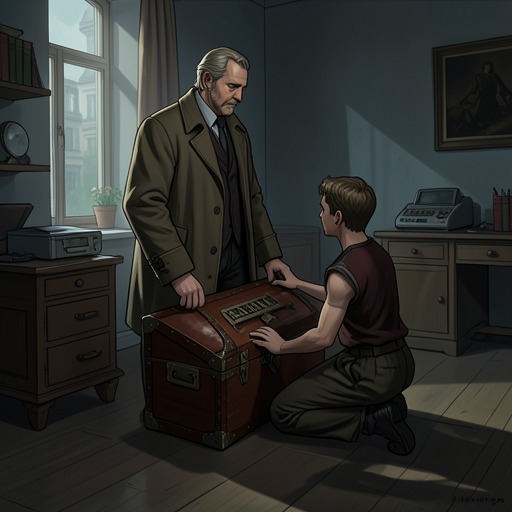
Ilana Visits Volodya in the Haifa Sanatorium
Black BoxIlana Visits Volodya in the Haifa Sanatorium is an encounter between Ilana Sommo and Volodya Gudonski, the father of Alexander Gideon, that moves between courtesy, confusion, painful recollection, and a final gesture of encouragement. In her letter to Alexander, Ilana recounts finding Volodya at a sanatorium on Mount Carmel and discovering that, although he cannot consistently place her, he can still offer her a moment of recognition and a plea to keep living with hope.
The Visit and Its Setting
Dated 15 August 1976, Ilana’s account begins with her journey from Zikhron to Haifa and her search for Volodya in the sanatorium garden. She finds him sitting alone at a table, with cake and yogurt before him. The scene locates their meeting apart from ordinary family life: Volodya is living in an institution, while Ilana has come specifically to see him. The garden’s quiet setting forms a pause in the letter’s account of family relationships, but it does not make the meeting simple or serene.
Ilana brings chrysanthemums bought at the Central Bus Station. Volodya rises and bows, takes the flowers, places one in his dressing-gown buttonhole, and puts the rest in his yogurt glass. He mistakes the visit for attendance at his funeral and addresses Ilana as Madame Rovina. The flowers thus enter the encounter first as a sign of mistaken death, then as an object he handles with deliberate care. His manners remain elaborate even as his grasp of the visit is uncertain.
Shifting Memory and Recognition
Volodya’s conversation does not proceed as a stable account of the present. He turns suddenly to Dostoevsky and asks whether such a person could be pardoned for cruelty and selfishness. The question opens onto his own troubled moral vocabulary: he distinguishes between ideals and conduct, but his thoughts veer between indignation, humor, and sadness. At points he seems to notice his own loss of direction; at others, he speaks with force as if addressing a remembered audience rather than Ilana in the garden.
His recollections move among figures and places from his past. He speaks of Binyomin, associated with an early settlement and a flock of sheep, and of Sioma, a man from Shirky in the Minsk Region whom he remembers as unusually decent. He also returns to Palestine as both dream and disappointment, setting its hoped-for promise against the painful disorder of lived experience. These are not presented as a continuous history. Their abrupt transitions show how Volodya’s memories arrive in fragments, while his recurring language of dreams, loss, and regret gives those fragments an emotional connection.
The past becomes personal when Volodya reflects on his marriage and the death of his wife. He recalls the mismatch between romantic gestures and his own conduct, and speaks as someone who believes he has damaged the gift of life. The visit does not supply a complete account of that marriage or settle the truth of every recollection. Instead, his self-accusation makes the scene a rare, exposed encounter with how he understands his own life: as a history marked by failure, bereavement, and shame.
Ilana’s Place in the Encounter
Ilana tries to bring the conversation back to Volodya’s present condition, asking about his health and the pain in his shoulder. He rejects the premise and shifts to speaking about another man, then wanders back into memories and reflections. Her effort to establish ordinary contact meets a mind that cannot reliably hold the same subject. Still, she remains with him, listens, and later asks directly whether he remembers who she is.
At that point Volodya withdraws his hand and becomes tearful. He admits that he cannot remember her and had not asked who she was or why she had come. Ilana settles him back in his chair, kisses his forehead, and tells him her name. He then identifies her as Ilana and as his son’s widow, before slipping again into confused references to people lost in the past. Recognition comes, but it does not restore a dependable grasp of time or circumstance. The exchange makes their family connection momentarily explicit while showing how fragile that recognition has become.
Farewell and Significance
Volodya’s reflections circle around the question of what people have done with the gift of life. He says that he has thrown away his revolver, presenting its disposal as an end to one part of his past, and asks Ilana what she has done with her own life. The account does not turn this into a tidy reconciliation or a full explanation of his history. Instead, his repeated returns to guilt and regret are interrupted by a direct appeal: Ilana should live and hope, and attend to the beauty of the autumn before the snow comes.
The farewell is expressed through another flower. Volodya rises, bows, picks up a chrysanthemum soiled by dust and yogurt, and delicately offers it to Ilana with a warning not to get lost in the snow. He then turns toward the sanatorium building without waiting for her answer. Ilana puts the sticky flowers in a trash can and takes the bus back to Jerusalem. The small exchange between them—an initially misidentified visitor, a prompted recognition, and a flower returned—gives the encounter its shape: care persists, but it cannot undo confusion or recover the past.
On the journey home, Ilana continues to feel the memory of Volodya’s hand as a source of consolation. That lingering impression gives the visit a consequence beyond the sanatorium scene itself. Volodya cannot sustain recognition, yet the contact remains with Ilana; his final instruction to live and hope stands beside, rather than erasing, the sorrow and uncertainty that have filled their conversation.